How to Get SEO Clients (Without Cold Calling): Find Ecommerce Stores That Need You
How to get SEO clients without cold calling: build a list of ecommerce stores, qualify them by SEO score and ad spend, then pitch with one finding.
If you're working out how to get SEO clients, most guides hand you the same list: post on LinkedIn, ask for referrals, go to networking events. It works, slowly. What they skip is the part that decides whether any of it works: who you're going after.
The short answer: pick one niche, build a list of stores in it, filter for the ones with weak SEO and money already going into ads, then email each with one specific finding. No cold calls and no guessing.
This guide walks through that method, then shows how LinkedIn and other channels fit in once you have a list. It's written for freelancers and agency owners who sell SEO and want a steady flow of clients instead of a lucky one every few months. The niche we'll use is ecommerce, because it's the easiest one to find and qualify with public data.
Why ecommerce stores make good SEO clients
Most SEO freelancers pitch whoever will listen: a dentist, a law firm, a SaaS startup. That works until every client needs a different playbook and you can't reuse anything. Ecommerce is easier to sell into and easier to keep, for four reasons.
- The results are easy to see. A store owner knows revenue day by day, so "organic traffic is up and organic revenue is up" is a story they understand and can check themselves.
- The work repeats. Product pages, collection pages, titles, descriptions, internal links and page speed are the same checklist from store to store, so each new client costs you less time than the last.
- The data is public. Before you write to anyone, you can see a store's platform, theme, estimated traffic and whether it runs ads. That is what makes the list-building method below possible.
- Organic search matters. Benchmarks compiled by Eightx from Similarweb data put organic search at roughly 15% to 50% of traffic for large ecommerce sites, depending on category. For a store that already pays for every ad click, that share is the traffic it isn't paying per visit for.
There's one trade-off. Store owners judge agencies on results, so you need to be comfortable pointing at organic revenue, not just rankings. If you are, ecommerce is a good niche to build on.
Build a prospect list instead of cold calling
Cold calling fails for SEO for a simple reason: you don't know who you're calling. A prospect list fixes that. When you know a store's niche, size and ad activity before you write a word, every message can be specific, and specific messages get replies.
A useful list has, for each store:
- the store URL and the owner's or team's email
- estimated monthly traffic
- signs of ad spend, such as ad pixels or paid traffic
- the theme it runs on
- some measure of how well the site is optimised for search
Those columns are the signals you'll use to qualify stores in the next section.
There are two ways to get there. You can build the list by hand with Google search operators, the Meta Ad Library and technology-detection extensions. It's free, but you check each store one at a time. Our guide to how to find Shopify stores in your niche walks through nine methods for it. Or you can start from a ready-made list, which is what ShopScoutr sells: a CSV of 10,000+ Shopify stores that run paid ads, with contact email, traffic, paid traffic, ad pixels, theme and SEO score for each.
Either way, start small. A well-qualified list of 100 stores in one niche beats a list of 10,000 you never work through.
Want to see what a list looks like? Download the free 300-row sample from ShopScoutr, with every column unredacted.
Qualify prospects: weak SEO, real traffic, money already spent on ads
A list of stores is not a list of clients. Most of the stores on it won't be worth your time, and the fastest way to find the ones that are is to check four signals before you write to anyone.
| Signal | Why it matters for an SEO pitch | How to check it by hand |
|---|---|---|
| Ads are running | The store already pays for traffic, so it has budget and knows what a visit costs. Organic search is how it lowers that cost. This is the strongest signal. | Search the store's name in the Meta Ad Library, or look for Meta, TikTok and Google pixels with a detection extension |
| Real traffic | Enough visits that better rankings turn into real revenue, and enough revenue to pay a retainer | A traffic estimator such as Similarweb |
| Weak SEO score | Room to improve. A store that is already well optimised has little to gain from you. | Run a free site audit on the homepage and two or three product pages, and look at titles, descriptions and thin product copy |
| Premium theme | A smaller tell: the owner has already paid to improve the storefront | Look up the theme with a detection extension and check whether it is a paid one |
Add one practical filter: a way to reach the owner. A store with no working contact email costs you time, however good it looks otherwise.
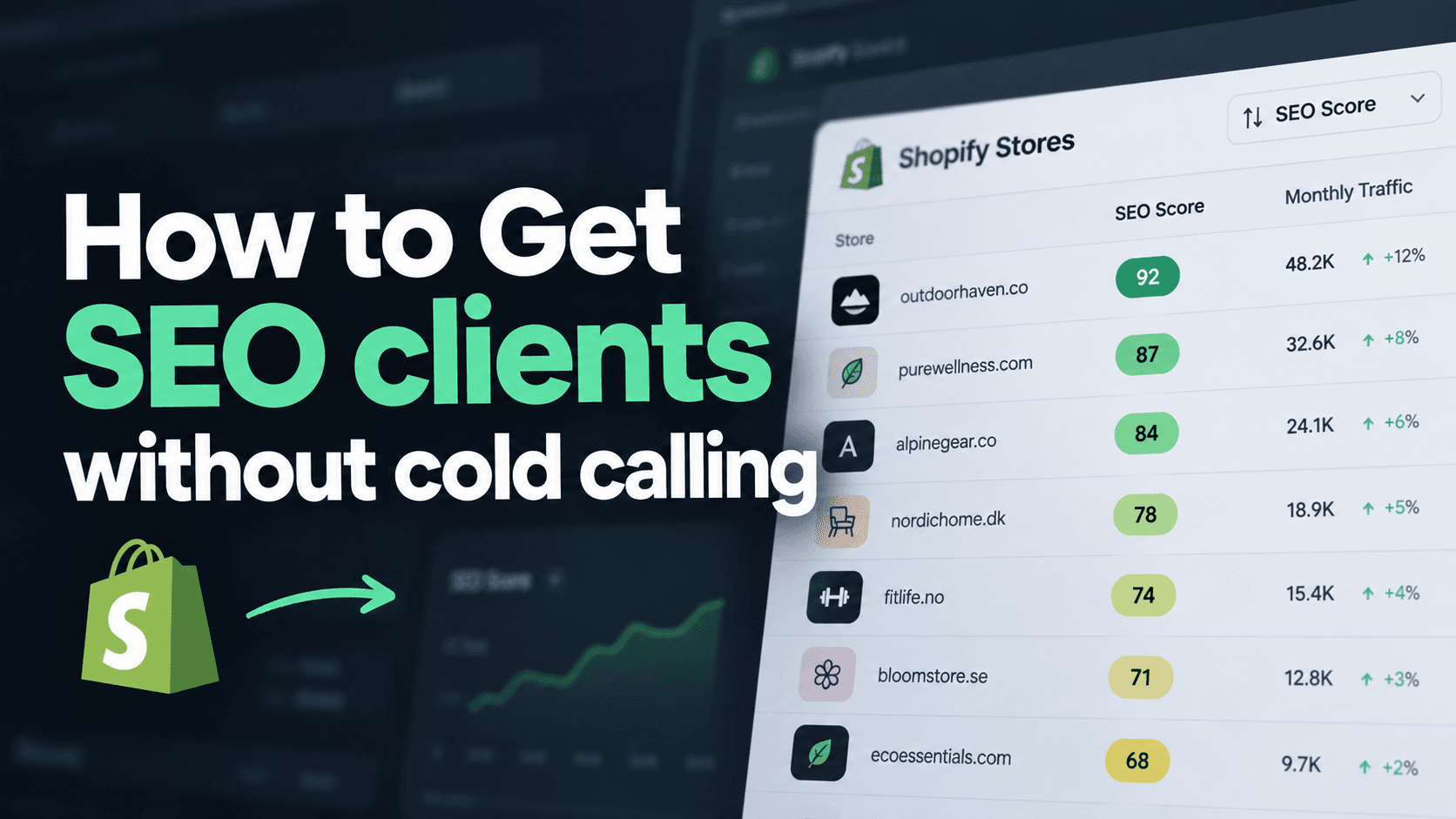
The best fits are stores that tick the first three boxes: ads running, real traffic and a weak SEO score. If you use a list with an SEO score from 0 to 100, start with the lowest scores among stores with traffic and ad activity, and adjust the cut-off once you see how the scores spread across your niche. Skip stores that look dormant, with no recent products, no ads and no contact.
Doing this by hand for hundreds of stores is the slow part. If you use a ready-made list, these signals are already columns, so qualifying is a sort and a filter.
Reach out without cold calling: one email, one finding
Once you have a short list of well-qualified stores, skip the phone and send an email built on one thing you noticed about that store. Not a pitch deck, not a list of services, and not a full audit. One finding, one small offer.
The finding is what separates your email from the generic pitches already sitting in the owner's inbox. Open the store, look at its best-selling collection or product page, and note one specific, checkable issue: a title tag that is just the store name, no description on a collection page, product copy copied from the manufacturer, or a page that loads slowly on mobile. Then keep it short. Under 100 words is a good target.
Subject: Your {collection name} page on {Store}

Hi {first name},

I was looking at {Store} and noticed {one specific finding, e.g. the title
tag on your {collection name} page is just "{title}"}. That page looks like
it gets steady traffic, and small fixes like this often help a page rank for
the searches you may be paying for in ads today.

I wrote down three quick fixes for that page. Want me to send them over?

{Your name}
{Your business name and postal address}
{One line on how to opt out}
The last two lines are not decoration. The FTC's CAN-SPAM guide says the law covers business-to-business email too, and it requires accurate sender details, a subject line that reflects the content, your valid postal address and a clear way to opt out, which you must honor within 10 business days. The FTC lists penalties of up to $53,088 per violating email. Rules differ by country, and this is not legal advice, so check the ones that apply to you and to the person you're writing to.
Three habits make this work better. Ask a small question the owner can answer in one line. Offer something you've already done, such as the three fixes, before asking for a call. And personalise from data you can see, like a page you looked at or ads you noticed, never from a mail-merge field alone.
How to get SEO clients on LinkedIn
LinkedIn works best as a second touch, not a first one. You already know which stores are worth contacting, so use LinkedIn to put a face to the email and to reach the person who decides. Search Engine Land's guide to finding SEO clients makes the same point about tone: the goal is to become a trusted advisor, not to sell in the first message.
- Take a store from your qualified list and find the founder or the head of ecommerce or marketing on LinkedIn.
- Follow them and comment on a post or two with something useful. A comment that adds a point beats a compliment.
- Send a connection request with no pitch in it, just a line on why you're connecting, such as your interest in their niche.
- Once they accept, send a short message with the same one finding from your email, and the same small offer.
- If you also emailed, mention it: "I sent you a note earlier about your {collection} page."
To get found in the other direction, post short teardowns of store pages, such as "three fixes for this collection page", and tag no one. Store owners who search for SEO help will see that you do the work in public.
Other channels that work alongside your list
A list-based method is the engine, but the other ways to find SEO clients are worth running in the background. They cost little and they compound.
Referrals. Once a store is getting results, ask the owner a direct question: "Is there anyone you know who'd want the same thing?" Store owners talk to other store owners, and a warm introduction skips the trust-building.
Partnerships. Look for businesses that serve the same stores but don't do SEO. Good fits in ecommerce are ad agencies, web designers, Shopify developers, email marketers and conversion specialists. Their clients often have weak organic traffic and a partner who can't help. You refer work to them, and they refer SEO work to you.
Content. Publish guides and teardowns that answer the questions your buyers search for. It takes months to pay off, but it brings in inbound leads that don't need an email at all.
Communities. Answer real questions in the places store owners ask them, such as the Shopify Community forums and ecommerce subreddits. Read each community's rules on self-promotion first, and lead with help, not a link.
Follow up and close the deal
Many replies come after a follow-up, not the first email. Plan two or three follow-ups a few days apart, and make each one add something new: a second finding, a screenshot of the issue, or a short note on what fixing it could mean for a page they already run ads to. "Just checking in" adds nothing.
When someone replies, keep the first call about their goals, not your services. Ask what they sell most, what they've tried for organic traffic, and how they judge success. Then show the one or two findings you already have and explain what you'd fix first.
For the offer, keep the first step small. A fixed-scope starter, such as an audit plus fixes on their top collection and product pages, is easier to say yes to than a 12-month retainer, and it gives you results to point at when you propose the ongoing work. Agree how you'll report on it before you start, ideally organic revenue and not just rankings, since that is the number the owner already watches.
Ready to build your first list? Grab the free 300-row ShopScoutr sample and try the qualification steps above on real stores.
FAQ
How do you find SEO clients online?
Pick a niche such as ecommerce, then build a list of stores in it from public data: search operators, the Meta Ad Library, technology-detection tools or a ready-made list. Qualify each store by ad activity, traffic and SEO score, then contact the best ones by email and LinkedIn.
How do you get more SEO clients?
Narrow your focus to one niche, qualify tightly so you only pitch stores that can benefit and pay, follow up two or three times with something new each time, and ask every happy client for an introduction. Volume matters less than fit.
How do you get SEO clients without cold calling?
Send a short email built on one specific finding about the store, follow up on LinkedIn, and add referrals, partnerships with other agencies, and helpful content. Every step in this guide works without a phone call.
Is cold emailing potential SEO clients legal?
In the US, the CAN-SPAM Act covers business-to-business email, so you need accurate sender details, an honest subject line, your postal address and a working opt-out. Other countries have different rules, so check the ones that apply to you and to your recipient.